Before you start
Choose an aid for a specific skill. Feedback is useful only when you understand what you are trying to change.
Updated . Researched equipment guide; not a hands-on product test. Our editorial approach.
A useful training aid gives you feedback on one specific skill. Start with the shot or movement you are working on, decide what improvement would look like, and choose the simplest tool that helps you measure it. This guide describes practice options, not tested product winners.
Alignment sticks: a reference for setup
Lay a stick safely on the ground to create a reference for your target line or stance. Check alignment before hitting, then remove the reference for a few shots to see whether the setup transfers. A stick shows where you are aimed; it does not guarantee a particular swing path.
Putting mirrors: check your setup
A mirror can help you observe eye position, shoulder alignment and putter placement. Use it to check a setup agreed with your coach rather than forcing every golfer into one position. Alternate short practice blocks with putts away from the mirror.
Putting gates: feedback on start line
A gate gives a clear task: start the ball through the opening. Choose a flat practice putt and an achievable gate width, then record successful starts out of a fixed number of attempts. A good start line still needs the right pace and read to produce a holed putt.
Impact feedback: locate the strike
Compatible impact tape or another manufacturer-approved face-marking method can show where the ball contacts the club. Look for a pattern across a group of shots. Strike feedback is most useful when you pair it with ball flight and a specific practice goal; it does not explain the cause of every miss.
Tempo trainers: find a repeatable rhythm
A tempo tool can provide a reference for the rhythm of practice swings. Follow its instructions and use an area with ample clearance. Then put it down and hit normal shots. The relevant question is whether your rhythm remains useful with your own club and a target.
Connection aids: use with a clear purpose
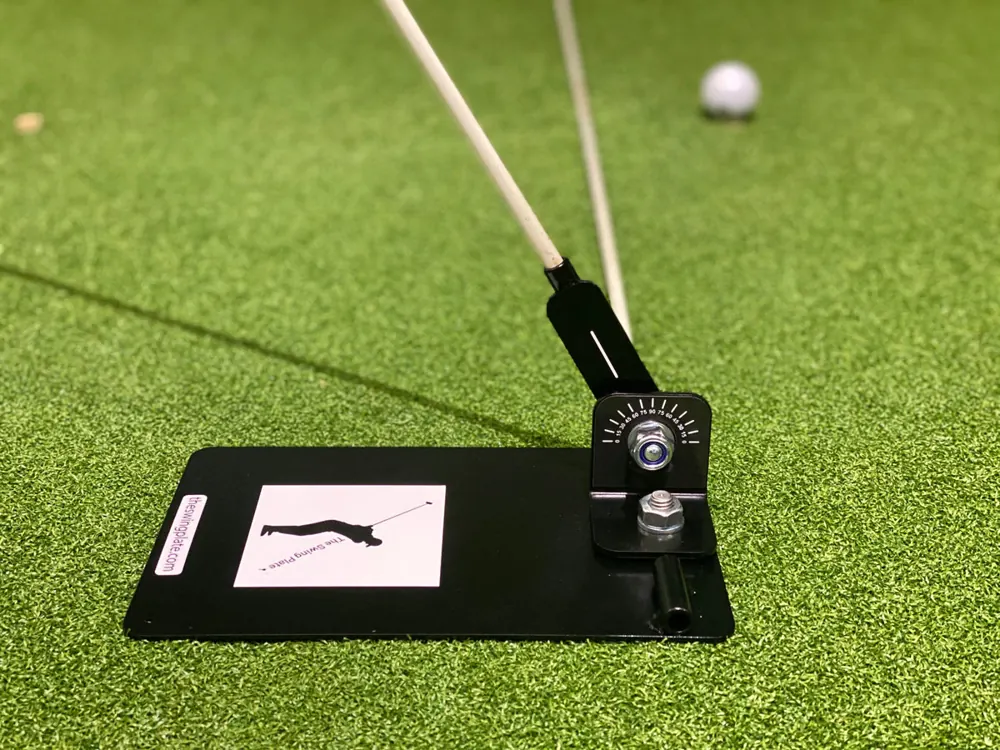
Wearable or arm-position aids constrain part of the motion. That can make a particular feel easier to notice, but the constraint may not suit every player or every swing change. Ask an instructor what the aid is intended to teach and when to remove it.
Speed-training tools: follow a structured plan
Weighted and lightweight training clubs are specialized tools. Follow the product’s instructions and appropriate coaching guidance instead of assuming that more repetitions or more weight is always better. Judge any useful change by what you can control with your playing clubs.
Launch monitors and swing sensors: check what is measured
Devices vary in the data they measure, the data they estimate and the space they require. Before buying, check indoor or outdoor requirements, compatible balls and devices, recurring charges and available metrics. A small practice area may rule out a product before its feature list matters.
Use data to answer a defined question, such as whether carry distances are becoming more consistent. Keep the ball and setup comparable between sessions, and avoid treating every displayed number as equally precise.
A simple practice session
- Choose one skill and record a short baseline without the aid.
- Use the aid for a focused block with a clear task.
- Remove it and repeat the original task.
- Write down what changed, including misses.
- Check again in a later session and on the course.
If the improvement disappears whenever the aid is removed, work on transferring the skill before buying another tool. A lesson can help identify whether the original practice goal was the right one.
Explore more gear guides
Back to gear